
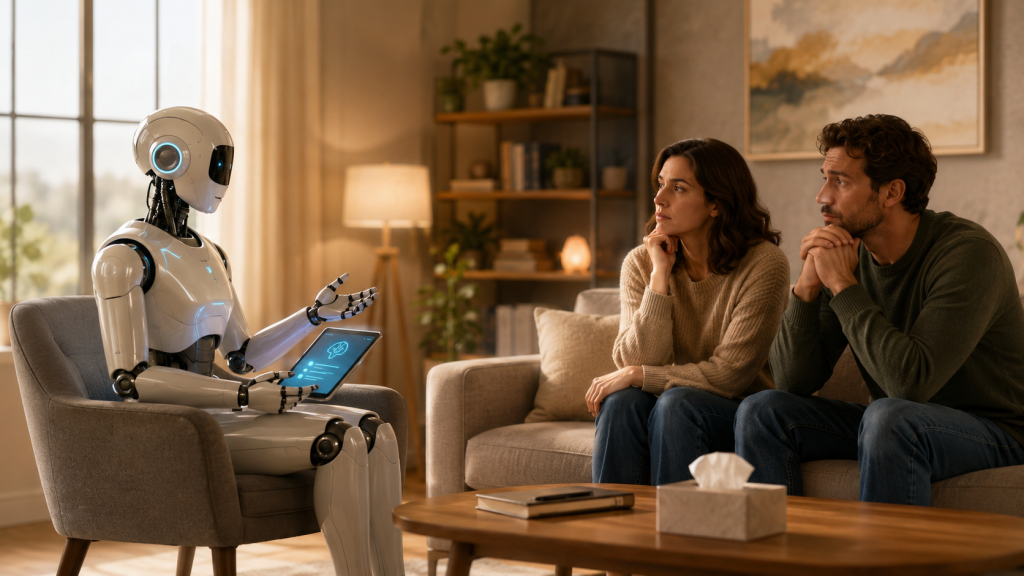
Many people now turn to ChatGPT for relationship advice, anxiety support, and emotional guidance. But can AI actually replace a therapist? In this blog, we explore what AI tools can help with, where they fall short, and why specialized couples therapy still matters.
Estimated read time: 9 minutes
Can ChatGPT Replace a Therapist?
Many people are asking this question quietly.
After a difficult fight with a partner. After a late night. After searching “therapist near me” and feeling overwhelmed by the options. Sometimes, after months of feeling disconnected, anxious, or emotionally exhausted.
AI tools like ChatGPT can feel surprisingly comforting at first. You type in a problem, and within seconds you get validation, communication tips, and step-by-step advice. For couples who feel stuck, or individuals struggling with social anxiety, grief therapy needs, panic disorder symptoms, or relationship stress, it can seem easier than opening up to a real person.
And honestly, AI can help in some ways.
But therapy is not just information.
Therapy is a relationship.
That difference matters more than most people realize.
At Vaughan Relationship Centre, we often meet people who have already spent months trying podcasts, books, YouTube videos, or AI tools before reaching out for couples counselling, marriage counselling or individual counselling. Many are intelligent, self-aware, and highly motivated. They are not looking for “quick advice.” They want real change.
So, can ChatGPT replace a therapist?
The short answer is no.
But the longer answer is more interesting.
Why People Are Turning to AI Instead of Therapy
There are understandable reasons people try AI first.
It feels private and low pressure
Talking to a psychotherapist can feel intimidating. Many couples worry they will be judged. Some individuals fear being misunderstood. Others have had negative experiences with therapy before.
Typing into AI can feel emotionally safer at first because there is no vulnerability in the room.
It is available instantly
You do not need to wait for appointments. You do not need to explain your insurance situation. You do not even need to know what type of therapy you might need before asking questions.
AI tools are immediate.
It helps organize thoughts
Some people use ChatGPT almost like journaling. They use it to prepare for couples therapy individual sessions, explore communication styles in relationships, or process difficult emotions before speaking with a therapist.
In that sense, AI can sometimes support reflection.
But reflection is not the same as transformation.
What AI Can Actually Help With
To be fair, AI tools can be useful in specific ways.
For example, ChatGPT may help you:
- Brainstorm conversation starters
- Understand attachment styles
- Learn basic communication techniques
- Explore what to expect in couples therapy
- Find questions to ask during marriage counselling
- Learn about panic and anxiety therapy
- Understand differences between types of psychotherapy
- Organize thoughts before therapy
- Practice expressing emotions
For some people, this lowers the barrier to seeking help.
A young ambitious couple might use AI to improve emotional vocabulary before attending couples therapy. An individual coping with social anxiety may use it to practice difficult conversations. Someone researching grief therapy might feel less alone after reading supportive information.
That can be valuable.
But emotional healing requires more than information delivery.
Therapy Is Not Just Advice
This is where many people misunderstand psychotherapy and counselling services.
A therapist is not simply giving tips.
An experienced couples therapist watches patterns unfold in real time.
For example, imagine a couple arguing about household responsibilities.
On the surface, it sounds like a practical disagreement.
But underneath, one partner may feel invisible. The other may feel constantly criticized. One shuts down when conflict starts. The other pursues harder because silence feels emotionally threatening.
A trained therapeutic counsellor notices these patterns immediately.
AI cannot truly track emotional energy, body language, tone shifts, relational trauma responses, or the nervous system reactions happening inside the room.
That matters because relationships are emotional systems, not logic problems.
Couples Therapy Works on Emotional Patterns
At Vaughan Relationship Centre, many couples come in believing their problem is communication.
But often, the real issue is emotional safety.
This is especially true for rebuilding couples recovering from betrayal, emotional disconnection, or intimacy struggles.
You can read hundreds of articles about communication styles in relationships. You can ask AI for scripts. You can search “couples therapy near me” for months without booking anything.
But change usually begins when people feel emotionally understood in a deeper way.
That is one reason Vaughan Relationship Centre has become so respected in relationship work.
AI Cannot Replace Human Connection
There is another important issue people rarely talk about.
Many people already feel emotionally isolated.
Established couples often say things like:
- “We feel like roommates.”
- “We barely talk anymore.”
- “We are constantly managing life, not connecting.”
Individuals dealing with anxiety, panic disorder, or burnout often feel emotionally disconnected from themselves too.
Using AI for support may temporarily reduce loneliness, but it does not replace genuine relational connection.
Therapy heals partly because another human being is fully present with you.
Not distracted.
Not rushing.
Not performing.
Present.
That experience alone can feel unfamiliar for many people.
A Therapist Challenges You Differently Than AI
AI tools are generally designed to remain agreeable and supportive.
Therapists do something more complex.
A skilled couples therapist may gently challenge avoidance patterns, defensiveness, emotional withdrawal, or unhealthy coping strategies.
For example:
- A partner who constantly intellectualizes emotions
- Someone avoiding accountability after betrayal
- A person using anxiety as protection against vulnerability
- A couple stuck in criticism and shutdown cycles
Real therapy involves discomfort sometimes.
Not harmful discomfort. Productive discomfort.
That process requires clinical judgment, emotional timing, and trust.
A trained couples therapist is not interchangeable with an AI chatbot because therapy is deeply relational and individualized.
Can AI Be Used Alongside Therapy?
Absolutely.
Many clients already do this.
Some use ChatGPT between sessions to:
- Reflect on emotions
- Journal thoughts
- Practice communication
- Review insights from therapy
- Create questions for sessions
Used carefully, AI can complement therapy.
It just should not replace it.
Think of AI as a tool. Not a therapeutic relationship.
Similar to how reading fitness advice online does not replace working with a skilled physiotherapist after an injury, AI cannot fully replace specialized relationship counselling online or in-person psychotherapy.
Why Specialized Couples Therapy Matters
Not every therapist specializes in couples work.
This is extremely important.
Many couples assume all therapists receive extensive relationship training. In reality, couples therapy requires advanced clinical skills beyond general counselling.
At Vaughan Relationship Centre, therapists are trained in approaches like:
- EFT
- Gottman Method
- Sex therapy
- Family Counselling
Different approaches help different situations.
For example:
- Sex therapist support may help with intimacy concerns and sexual disconnection
- Family counselling services may support parenting stress and family conflict
Specialized training matters because relationship distress is layered and emotionally complex.
What If You Feel Nervous About Starting Therapy?
That is normal.
Many people delay therapy because they worry:
- “What if it does not help?”
- “What if my partner refuses?”
- “What if the therapist takes sides?”
- “What is couples therapy like?”
- “Will we just fight in front of someone?”
Good couples counselling is not about assigning blame.
A skilled counselling professional helps both people understand the cycle they are trapped inside together.
Even couples therapy for one person can sometimes create meaningful shifts in a relationship dynamic.
You do not need to have the perfect words before starting.
You just need willingness.
AI Cannot Fully Understand Your Story
Here is something important many people overlook.
AI predicts language patterns.
Therapists understand human patterns.
Those are not the same thing.
A good counsellor considers:
- Childhood attachment experiences
- Trauma history
- Emotional regulation
- Family systems
- Cultural context
- Relational dynamics
- Nervous system responses
- Non-verbal communication
- Emotional safety
That level of understanding develops through training, experience, and human connection.
Especially for rebuilding couples or individuals navigating grief therapy, panic and anxiety therapy, or intimacy concerns, emotional nuance matters.
There is no shortcut around that.
The Future of AI and Therapy
AI will probably continue becoming part of mental health support.
It may improve accessibility.
It may help people learn emotional language.
It may encourage hesitant people to seek therapy sooner.
Those are positive developments.
But the future of therapy is not humans versus AI.
It is understanding where technology helps and where human connection remains essential.
For couples struggling with emotional disconnection, unresolved conflict, betrayal, intimacy concerns, or long-standing communication patterns, real therapeutic relationships still matter deeply.
And likely always will.
Final Thoughts
If you have been relying on AI for emotional support, you are not alone.
Many thoughtful, intelligent people do.
But if you notice the same arguments repeating, the same loneliness lingering, or the same anxiety resurfacing despite all the advice and self-help content, it may be time for something more relational and personalized.
Therapy is not about getting perfect answers.
It is about understanding yourself and your relationships in a deeper, more honest way.
That process happens best with another human being who is trained to help guide it safely.
FAQs
Can ChatGPT help with relationship problems?
AI tools can help people reflect, organize thoughts, and learn communication strategies. However, they cannot replace the emotional attunement and clinical expertise of a trained couples therapist.
What is couples therapy like?
Couples therapy usually involves identifying communication patterns, emotional triggers, and recurring cycles within the relationship. A therapist helps both partners understand each other more deeply and build emotional safety.
Is AI therapy as effective as real therapy?
AI can provide educational support and emotional reflection, but it cannot fully replace psychotherapy because it lacks human connection, emotional responsiveness, and clinical judgment.
Can one person attend couples therapy alone?
Yes. Couples therapy for one person can still create meaningful insight and relational change, especially when one partner wants to begin understanding unhealthy patterns.
What is EFT therapy?
Emotionally Focused Therapy (EFT) is an evidence-based approach that helps couples strengthen emotional bonds and understand the deeper attachment needs underneath conflict.

About Vaughan Relationship Centre
Vaughan Relationship Centre is a specialized couples therapy and relationship counselling practice in Vaughan, Ontario, offering both in-person and secure online therapy services. We support couples and individuals throughout Vaughan, Toronto, and across Ontario with expert relationship-focused care tailored to their unique needs.
Founded in 2016, our therapists bring 10 to 25 years of clinical experience and advanced training in Emotionally Focused Therapy (EFT), the Gottman Method, CBT, and DBT, with a focus on couples therapy, marriage counselling, discernment counselling, and sex therapy.